
The Lost Art of Reading
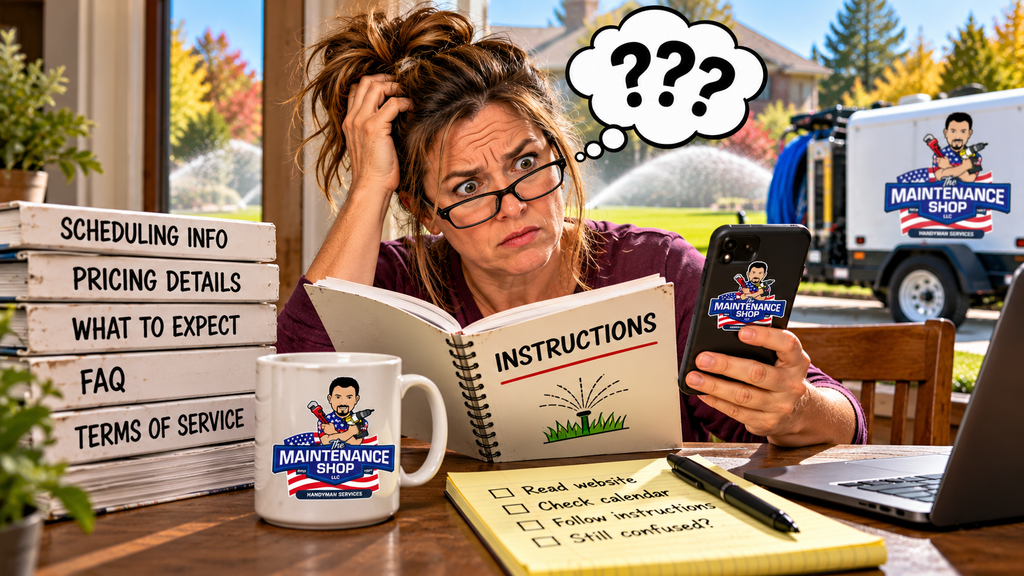
A Completely Unscientific Study of Human Nature
Somewhere along the way, humanity developed the ability to communicate across continents, put a man on the moon, build computers that fit in our pockets, and create artificial intelligence capable of answering questions in seconds.
And then, apparently, we stopped reading.
Not entirely, of course. We still read things that interest us. Sports scores. Restaurant menus. The occasional Facebook argument. The expiration date on a gallon of milk, usually after we’ve already poured it.
But instructions?
Those appear to have become optional.
I’ve been conducting an informal study of this phenomenon from my office at The Maintenance Shop. My research facility consists of four monitors, a keyboard, an increasingly suspicious supply of Coke Zero, and enough incoming messages to make an air traffic controller request a quieter assignment.
The results have been fascinating.
And by fascinating, I mean I may need another Coke Zero.
The Experiment
Let’s say you have a website with a calendar.
Directly above that calendar is an explanation of what the calendar means, how scheduling works, and why certain dates may or may not appear.
The information is clearly written. It’s visible. It’s in English.
A visitor opens the page, scrolls past the explanation, looks at the calendar, and immediately sends a message asking a question answered by the paragraph they just passed.
This is not an isolated occurrence.
This is a recurring scientific event.
I’ve developed a theory that certain words become invisible when placed directly above something a person wants to click.
I call it Selective Instruction Blindness.
It hasn’t been accepted by the scientific community yet, mostly because I haven’t submitted it to anyone. I’m too busy answering questions about the instructions.
The Five Stages of Not Reading
After years of observation, I’ve identified five distinct stages.
Stage One: Confidence
The subject approaches the website believing they already know what to do.
Stage Two: Scanning
The subject moves rapidly down the page, occasionally noticing a bold heading or an interesting picture.
Stage Three: Improvisation
Having skipped the instructions, the subject makes an educated guess.
The education involved remains under investigation.
Stage Four: Confusion
The guess doesn’t produce the expected result.
Stage Five: Contacting Someone Who Wrote the Instructions
The subject sends a message asking for clarification.
The answer is copied, sometimes nearly word for word, from the instructions that were skipped.
The subject replies, “Oh, okay. Thanks!”
And somewhere in Idaho, a man opens another Coke Zero.
Technology Has Made This Better. Allegedly.
We now have devices that can translate languages, navigate unfamiliar cities, recognize faces, and tell us what the weather will be next Thursday.
Yet we’ve somehow developed an extraordinary ability to overlook a sentence that says, “Please read this before proceeding.”
I sometimes wonder what would happen if we put instructions on the back of a cereal box.
Would people still read them?
Or would we start receiving emails asking how to pour the milk?
To be fair, I’m not immune to human nature. I’ve overlooked things myself. The difference is that when I discover the answer was sitting in front of me the entire time, I generally try not to announce it to the world.
Unfortunately, the world occasionally announces it to me.
A Theory About Common Sense
People often say common sense isn’t very common anymore.
I’m not sure that’s entirely accurate.
I think common sense is still out there. It’s just competing with convenience, impatience, distractions, and the irresistible urge to click something before understanding what it does.
We’re all in a hurry.
We want answers immediately.
And sometimes, in our rush to save thirty seconds reading an explanation, we spend five minutes asking someone to explain it.
That’s not efficiency.
That’s taking the scenic route to a destination you were already standing in front of.
The Conclusion
After reviewing the evidence, I’ve reached three conclusions.
First, people are generally good, decent, and well-intentioned.
Second, human beings are capable of astonishing achievements.
Third, if you put a large sign on a door that says PULL, someone will push it, push it again, look annoyed, and eventually ask whether the building is closed.
None of this is intended to insult anyone. It’s simply an observation about the wonderfully unpredictable creatures we call human beings.
Including me.
Although I do reserve the right to stare at my monitors occasionally and wonder how our species managed to invent space travel.
And if you’re wondering what any of this has to do with sprinkler blowouts, the answer is simple.
Somewhere on our website, there’s probably a paragraph explaining that.
You just have to read it.
Welcome to Sprinkler Blowout Land, where the compressors run on air, the office runs on Coke Zero, and the instructions are apparently hiding in plain sight.
Important Links:
Understanding Freezing Temperatures and Sprinkler Systems: https://treasurevalleyrepairs.com/blog/?p=5192
Sprinkler Blowout Calendar: https://treasurevalleyrepairs.com/calendar.html
Sprinkler Blowout Stats: https://treasurevalleyrepairs.com/sprinkler-blowout-stats.html
Sprinkler Blowouts Terms Of Service: https://treasurevalleyrepairs.com/sprinkler-blowout-terms-of-service.html
Cancel Service: https://forms.gle/bCqx5fqKrZt5nNLV8
Leave Us Reviews For A Chance To Win A Tucanos $25 Gift Card: https://treasurevalleyrepairs.com/newsletters/give-us-some-love.htm
Pre-winterization Instructions: (Print the image that most closely matches your system and put by your sprinkler timer)
PVB: https://www.treasurevalleyrepairs.com/images/pvb-winterize-instructions.webp
RP: https://www.treasurevalleyrepairs.com/images/rp-winterize-instructions.webp
DC: https://www.treasurevalleyrepairs.com/images/dc-winterize-instructions.webp
Pump: https://www.treasurevalleyrepairs.com/images/pump-winterize-instructions.webp
Zone Valves: https://www.treasurevalleyrepairs.com/images/valve-pressure-relief.webp
Irrigation Filter: https://www.treasurevalleyrepairs.com/images/filter-winterize-instructions.webp